
The midnight sun in Finland
The real midnight sun is only in the north
The midnight sun means that the sun remains above the horizon even at midnight. In Finland, you can experience this phenomenon north of the Arctic Circle, most notably in Lapland. The farther north you travel, the longer the period without sunset lasts. In the south of the country, by contrast, the sun dips below the horizon, even though it gets dark only briefly in June and July. These are more accurately described as bright or white nights. This distinction matters if your goal is specifically to see the sun above the horizon at midnight.
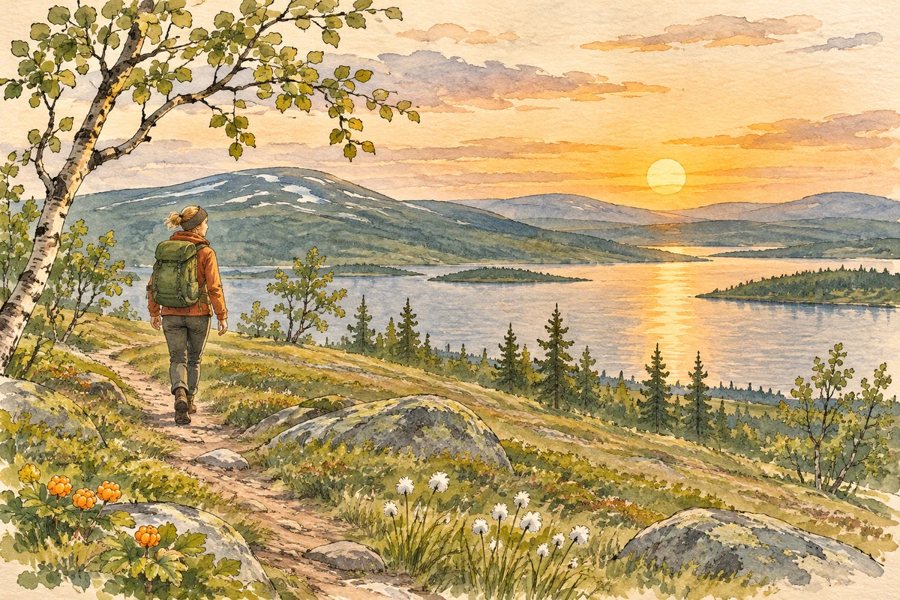 KI-generierte Illustration: Tief stehende Sommersonne über einer Fjälllandschaft mit Seen und einer wandernden Person.
Photo: Max-TD / OpenAI
The light changes the rhythm of the day: in the evening, the landscape takes on a warm, golden glow, while the time on the clock tells you little about how bright it is. To make the most of the long hours, you could save a walk, a short paddle or a sauna visit for late in the day. A quiet spot by the water is especially appealing. Around Utsjoki, the midnight sun season lasts from late spring into July; the farther north you are, the longer the sun stays above the horizon. Rovaniemi is an easily accessible gateway to Lapland. The bright season is also the opposite of the dark nights for seeing the northern lights. One possible route links the city with nature stops on a Lapland tour.
A trip that follows the light
The prospect of a bright night is no reason to fill every hour of the day with activities. Many travelers sleep better when their accommodation can be thoroughly darkened and activities don’t run late every night. A sleep mask and a planned block of downtime can help, especially if you want to stay in your usual routine after a long journey. Brightness is an advantage on excursions, but distance, terrain and weather still determine how much is comfortably manageable in a day.
For a first trip, you can combine the midnight sun with lakes, city visits and a day or two in nature. Rovaniemi offers an urban introduction to Lapland. For destinations farther north, longer distances and overnight stops along the way are part of the itinerary. Choose your gear based on what you’ll actually be doing: light layers, a rain layer and comfortable shoes are more useful than assuming it will automatically be warm at night. The climate page for Finland explains regional differences.
Summer light in cities, forests and by the lake
Even south of the Arctic Circle, it stays light for a long time around the summer solstice. Helsinki and Turku have white nights, although you can’t see the midnight sun there in the geographical sense. The light can make a seaside walk last longer or accompany a late meal outdoors. In the Lake District, the contrast between the shore, forest and water is especially striking when the sun hangs low. If you’re planning to visit several cities, you can include Helsinki, Turku and Tampere in a leisurely rail trip.
The season is short and varies by region. In the north, the period when the sun doesn’t set begins in late spring and continues into summer; in the south, the most spectacular light comes around the summer solstice. What you see depends on your location, the horizon and the weather. Spending several evenings in one place gives you some leeway if it’s cloudy or windy, and a chance to catch a particularly clear sky. A tour with enough nights in each place is often more rewarding than a long list of stops. For a compact, relaxed week-long itinerary with fixed bases, see Finland in seven days.
