
The Northern Lights in Finland
Where the chances are best
Finland lies on the southern edge of the aurora oval, so the statistical odds improve farther north. The far north of Lapland is especially promising, around the area between Kilpisjärvi and Utsjoki. The landscapes around Inari, Saariselkä and other northern towns are also dark, with open views of the sky. Sightings are possible farther south, in places such as Oulu and Kuopio, but are less common; on the southern coast, around Helsinki, stronger geomagnetic activity is usually needed. These are probabilities for dark nights with sufficiently clear skies, not a forecast for any particular day of your holiday.
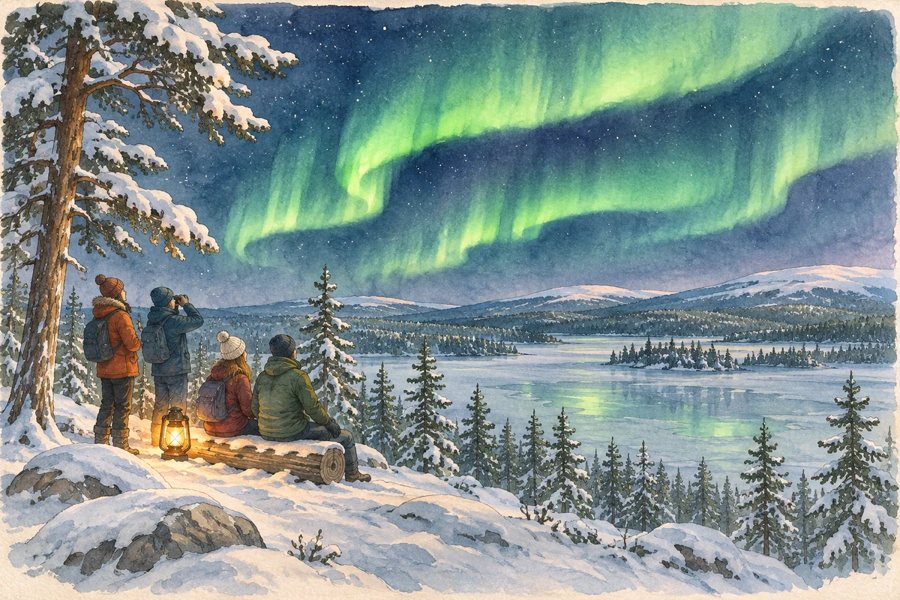 KI-generierte Illustration: Nordlichter über einem verschneiten Wald und See in einer nordischen Winterlandschaft.
Photo: Max-TD / OpenAI
If seeing the Northern Lights is the main focus of your trip, spending several nights at the same northern location gives you better viewing opportunities. A quick trip north from the south can make for a pleasant journey, but offers fewer chances than a longer stay. If you’d like to combine Lapland with cities, you can start in Rovaniemi and use the city as a base; compare train, bus and car options in the guide to Getting around Finland. For a longer stay immersed in nature, see A Lapland road trip.
Season, darkness and weather
The dark viewing season runs roughly from late summer to early April. In midsummer, the bright light of the midnight sun makes the Northern Lights impossible to see, even when there is auroral activity in the sky. Autumn and spring are considered somewhat more active; for northern Finland, the Finnish Meteorological Institute highlights March and early April as a favourable combination of activity and weather. Autumn nights may still offer open water and reflections, while snow shapes the landscape in winter. If you’re also looking for long, light-filled days, compare the season with The midnight sun in Finland.
Clouds are the main natural obstacle to viewing: even a strong aurora is invisible behind a solid blanket of cloud. Finnish weather can change quickly, and autumn and winter are often cloudy. A clear night is therefore no minor detail—it’s part of the planning. Cold, clear nights also call for warm layers, sturdy insulated footwear and a sheltered spot where you can wait without rushing. A dark location away from bright roads and buildings improves contrast, provided it is safe to reach.
What your eyes and camera will see
The Northern Lights are not a constant wall of light. Some nights bring only a faint arc; on others, bands move quickly, with brightness and colour changing over time. The human eye often perceives faint displays more subtly than a photograph does. A tripod and your phone’s night mode, or a longer camera exposure, can capture more colour and detail. The resulting image is a photographic interpretation of the scene, and not necessarily what your eyes see at that same moment.
Patience and a wide horizon help in practice. The most common viewing time is around midnight, but the Northern Lights can appear as soon as the sky is dark. A relaxed evening without long drives between locations, a warm place to retreat to and time to enjoy the night landscape make the experience more pleasant. A road trip doesn’t have to end with a long drive every evening. Finland in seven daysbrings together several stops with peaceful places to stay, while Hiking in Finlandoffers ideas for daytime activities.
