
Hiking in Finland
A good hike in Finland starts with a route suited to your fitness, experience, the season and the time available. Forests, lake districts, coastal trails and the open fell landscapes of Lapland all present different challenges. Plan not only the distance, but also the terrain, elevation profile, return journey, a weather contingency and options for cutting the hike short.
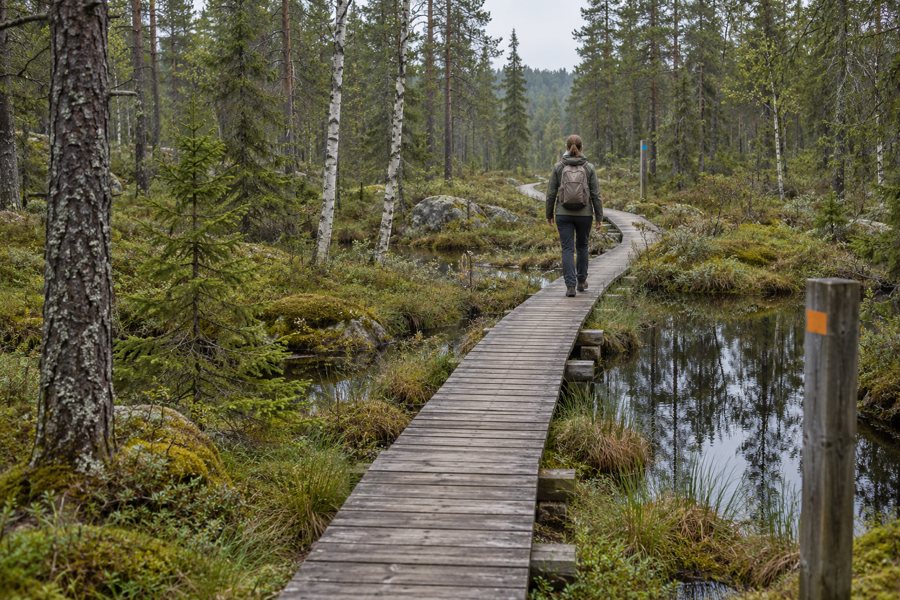 Wanderer auf einem Holzbohlenweg durch eine grüne finnische Moor- und Waldlandschaft.
Photo: AI-generated illustration (OpenAI)
Choosing the right hike
For an initial assessment, compare the distance, estimated walking time, elevation gain and trail conditions. A short loop with places to rest may be a better fit for families than a long stage with no exit points. Multi-day hikes also require a reliable map, overnight arrangements and enough time to allow for slower conditions. Trail markings and conditions can change, so check the latest information for the area you plan to visit.
The landscape affects how you prepare: on coastal and island trails, wind and crossings may shape your plans, while in Lapland, distances and changing weather are more significant factors. Compare the regions of Finland and choose your accommodation and travel arrangements so that getting to the start and returning from the end of the hike are practical. For multi-day stays, there are various types of accommodation to choose from.
Short day hikes or a multi-day trek?
Finland’s hiking destinations range from one-hour nature trails to multi-day treks with overnight stays. If you have limited time, short loops are a good choice, such as hiking in Nuuksio, hiking in Repovesi or selected nature trails and short family hikes. If you want to spend longer on the trail, plan the distance, elevation profile, stages and overnight options together. The full Karhunkierros is an extensive long-distance hike; the Pieni Karhunkierros is a separate, much shorter loop for a day’s hiking, with different starting points and requirements. In the north, the Hetta–Pallas route takes several days through the fell region. In the hilly landscape of Koli, the Herajärvi Loop also offers longer stages and route options. The more days a hike takes, the more important it is to plan realistic daily distances, suitable equipment and practical transport to the starting and finishing points.
Equipment for the route and season
Sturdy, well-broken-in footwear, weather-appropriate clothing and an extra warm layer can help you cope with changing conditions. Bring water, food, a charged phone and an offline map; in remote areas, don’t rely on mobile coverage. For longer hikes, pack a first-aid kit and extra supplies in case of delays. In winter, short daylight hours, cold and suitable equipment are crucial—a summer route is not automatically suitable for winter hiking.
If you’re hiking in a remote area, tell someone you trust your route and expected return time. Turn back if the weather, trail conditions or your own energy levels no longer match your plan. The official guidance on hiking safety offers further advice on preparing and staying safe on the trail.
Accommodation, food and nature conservation
For a day hike, returning to your accommodation is often the simplest option. For longer routes, include open huts, campsites or other accommodation—and, where necessary, reserved sleeping places—in your stage planning. Plan your stages so that a late start or a change in the weather won’t force you to continue in risky conditions.
Bring enough water and food for the planned duration, and allow for breaks or weather to make the return journey longer. Don’t count on being able to buy supplies or refill water on the way unless this has been confirmed for your specific route.
Rules differ between open-access nature areas, protected areas and marked facilities. Overnight stays, fires, fishing and dogs may be subject to local restrictions. Finland’s national parks have additional area-specific conservation rules. Follow local trail and conservation regulations, take your rubbish with you and avoid damaging sensitive areas.
Organising a hiking trip
Coordinate your travel to and from the area with your daily stages and overnight stops. For longer distances, staying in one base accommodation and taking several day hikes may be more practical than changing accommodation frequently. The travel information for Finland can help with general travel planning. Just before setting out, check the weather, trail notices and local guidance rather than relying on older trip reports.
Comparing routes in practical terms
Distance alone says little about how demanding a hike will be. Compare elevation gain, terrain, exposed sections, places to rest and options for shortening the route. Check whether the start and finish are in the same place or whether you’ll need transport back. If a hike connects several trails, make a note of junctions and key landmarks in advance. This makes it easier to judge whether your planned time will be enough, even at a slower pace.
When choosing a base, it’s worth looking at Finland’s regions. Staying near the trailhead can make for a more relaxed morning; compare suitable accommodation and check what transport is actually available. For a longer round trip, make sure your arrival time, return journey and available daylight all work together.
Hiking with children or a group
Plan around the person with the slowest pace and least stamina. Children often need more frequent breaks, easy intermediate goals and ways to end the hike early. Check in advance whether the trail includes narrow boardwalks, steep steps or other sections that may be difficult for your group. Pack water and food so they’re easy to reach on the way, and agree on a meeting point in case the group gets separated.
In a larger group, make sure everyone knows the route. Set places to take breaks and decide together when to turn back. A safe, shorter hike is more worthwhile than a destination that can only be reached under time pressure. For outings with children, the article on family activities offers more ideas for suitable day trips.
Use a quick checklist before setting out
Check the weather, trail notices, daylight, transport and expected return time. Download maps and important information to your device, and bring a power bank. Tell someone you trust about hikes in remote areas. Check your footwear, rain gear and warm spare layer, and pack according to the length of the hike. If an important detail is still uncertain, choose an easier route or postpone your start.
If you’d like to spend several days outdoors, you can combine a hiking trip with a stay at a suitable campsite in Finland. In bad weather, a visit to a water park may also be an option for families as a separate day out; check travel arrangements, opening hours and conditions in advance.
Frequently asked questions about hiking in Finland
Which hike is suitable for beginners?
Choose a well-described loop of manageable length, with clear markings and an easy way back. Adjust the route to the slowest person in your group.
Can I rely on mobile phone coverage?
Coverage is not guaranteed everywhere in remote areas. Download maps for offline use and plan your navigation and emergency communications to suit the route.
