
Finland in 7 Days
One week, one clear focus
Seven days in Finland doesn’t mean crossing the entire country. An enjoyable week-long trip focuses on one corridor and two or three overnight bases. First-time visitors can use Helsinki as their arrival point, then choose a city inland and finish in a lake region. This offers a mix of urban life, water and forest without having to pack every day. Alternatively, spend the entire week on the west coast or in the Lakeland region. For an overview to help you choose between the coast, Lakeland and Lapland, see round trips in Finland.
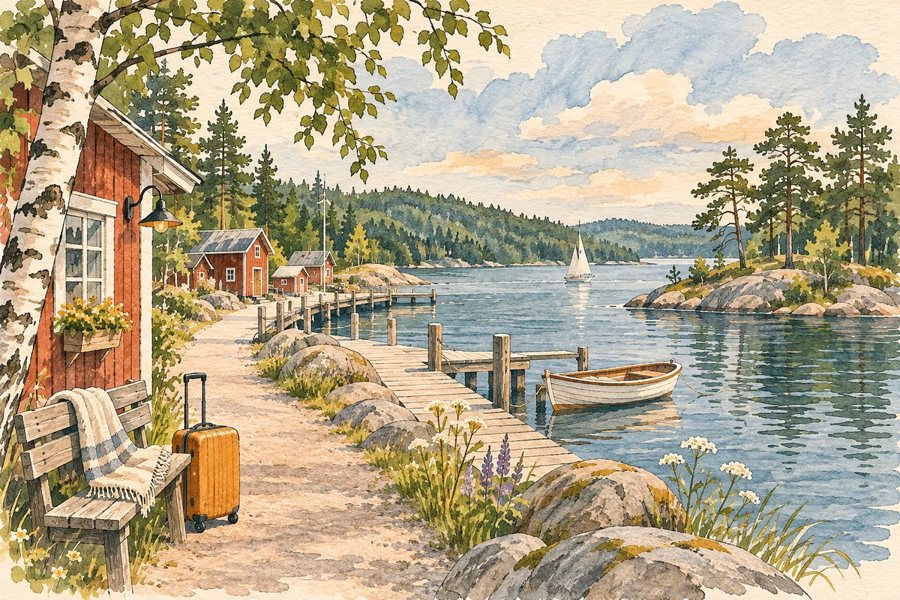 KI-generierte Illustration: Rotes Holzhaus, Bank und Steg am bewaldeten Seeufer.
Photo: Max-TD / OpenAI
One possible itinerary starts with two nights in Helsinki, so your arrival, city walks and a trip to the islands aren’t all crammed into a single day. Then spend two nights in Tampere, a good stop for museums, city life and waterfront paths. Your final two nights could be in Lakeland, for example in Kuopio or Savonlinna. The exact order depends on your arrival point and mode of transport; if you’re travelling by train and bus, accommodation near the relevant connections is convenient.
A flexible daily rhythm
Day one is for arriving and getting your bearings in Helsinki. Day two leaves time for the city centre, the waterfront promenade or a ferry trip; if you arrive late, simply make it a quiet evening. On day three, take the train to Tampere, where half a day is enough to settle in and the other half to go for a walk. Spend day four in the city. On day five, continue to Lakeland. Keep day six for a longer excursion or a relaxing boat trip, then depart on day seven. You can adapt the stages to your arrival point and mode of transport.
If you prefer water and castles, you could instead plan two nights in Savonlinna and several nights in Mikkeli. Kuopio, Savonlinna and Mikkeli are the highlights of the Lakeland round trip. Train travel between larger cities provides a practical foundation, but rural jetties, national parks and smaller places to stay often require additional bus, taxi or boat journeys. The specific connections depend on your travel dates and destination; allowing plenty of time for transfers makes the day more resilient than relying on a tight connection.
With or without a car?
A rental car gives you more freedom to explore the lake region and choose more secluded accommodation. But you’ll also need to factor in finding parking and driving back after an excursion. Without a car, you can follow a route linking well-connected cities and main transport lines; Finland without a car connects these destinations by train and bus. Transport in Finland covers trains, long-distance buses, roads and ferries.
If you’re travelling in summer, you’ll benefit from long, bright evenings, but should still plan breaks. In spring and autumn, conditions can vary considerably between the south and north; in winter, daylight and road conditions become especially important. Waterproof clothing and layers are better suited to changing temperatures than a daily schedule that relies entirely on sunshine. Choosing one region well offers more time to relax and take in the sights than trying to tick off every well-known place in seven days.
