
Suomenlinna near Helsinki
A fortress at the gates of Helsinki
Suomenlinna lies on a group of islands at the entrance to Helsinki Harbour. The sea fortress was built from 1748 onward during Swedish rule, intended both as a maritime defense system and as a base for the archipelago fleet. Today, it is one of Finland’s best-known cultural destinations and also a residential district. Around 200 buildings, miles of fortress walls, courtyards, churches and historic harbour facilities are spread across several islands. In 1991, Suomenlinna was added to the UNESCO World Heritage List. A visit to the historic site can be combined with a stay in Helsinki; for other cultural destinations, see the overview of sights and museums in Finland.
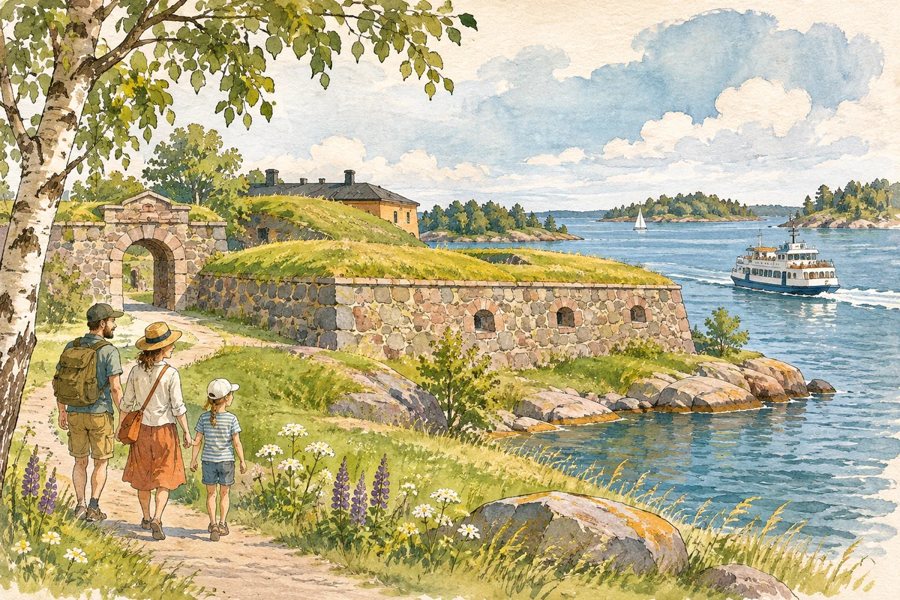 KI-generierte Illustration: Spaziergänger an einer begrünten Seefestung mit Booten vor der Küste.
Photo: Max-TD / OpenAI
From Sveaborg to Suomenlinna
During the Swedish period, the fortress was called Sveaborg, or Viapori in Finnish. Its construction reflects the changing political circumstances of the Baltic region. In 1808, the fortress surrendered to Russian troops and became part of a Russian military base. After Finland gained independence, it came under Finnish administration in 1918 and was given the name Suomenlinna, meaning “Castle of Finland.” The site later lost its military function and passed into civilian administration in 1973. These layers of history are visible today: bastions and walls stand alongside barracks, shipyard facilities and residential buildings from different periods. Suomenlinna is therefore more than a backdrop; it is a layered historic place whose present-day use is part of its story.
The Blue Route and key sights
The marked Blue Route leads from the main quay in the north to the King’s Gate in the south. It is about one and a half kilometres long and links many of the best-known sights. By the northern quay stands the pink Jetty Barracks, a gatehouse dating from the Russian period. Farther south is the Great Courtyard, laid out in the 18th century as the fortress’s administrative centre. It is home to Ehrensvärd’s tomb and the Ehrensvärd Museum, housed in the former commandant’s residence. Another stop is the dry dock, construction of which began in 1750 and which was used for ships of the archipelago fleet. The old shipyard can be viewed from the lookout point. At the end of the route, the King’s Gate marks a grand harbour entrance dating from the 1750s. For comparison with a medieval fortress on Finland’s southwest coast, see Turku Castle; an overview of other cultural sites is available in Finland’s museum landscape.
More than an open-air museum
The fortress is part of everyday life in Helsinki: people live and work on the islands, cafés and museums occupy historic buildings, and the waterfront is also a popular public space. There is no admission fee for the fortress grounds themselves; the HSL passenger ferry from Market Square (Kauppatori) takes visitors to the main quay in front of the Jetty Barracks. The crossing takes about 15 minutes. Individual museums and facilities have their own terms and conditions. The Blue Route helps first-time visitors find their way, while a longer stay leaves time to explore quieter paths and enjoy views of the harbour. Some buildings are still used as homes or workplaces, so the route combines historic sights with an active neighbourhood.
A visit amid the island scenery
The paths cross rock, grassy areas and fortifications. Comfortable shoes are a good idea, and the island setting feels especially pronounced when it’s windy, more so than in the city centre. Walking from the quay to the King’s Gate, visitors experience a transition from the busy harbour area to open coastal views. Longer walks can be combined with a return to Helsinki and other city visits, such as boat trips in Finland or hikes and walks. Suomenlinna is an excellent destination for anyone looking to combine architecture, military history and island atmosphere.
