
Turku Castle
A castle with many historical roles
Turku Castle is one of the defining historic buildings of southwestern Finland. The castle’s origins date back to the 1280s; over the centuries, it was expanded and its function changed several times. What began as a defensive stronghold at the river mouth became, for a time, an administrative and commercial centre, and later a residence, barracks and, finally, a museum. Today, a visit takes you through buildings where different eras overlap. The castle is near the harbour and complements a stay in Turku, whose history is closely linked to the site. For more cultural destinations around the country, see the guide to attractions and museums.
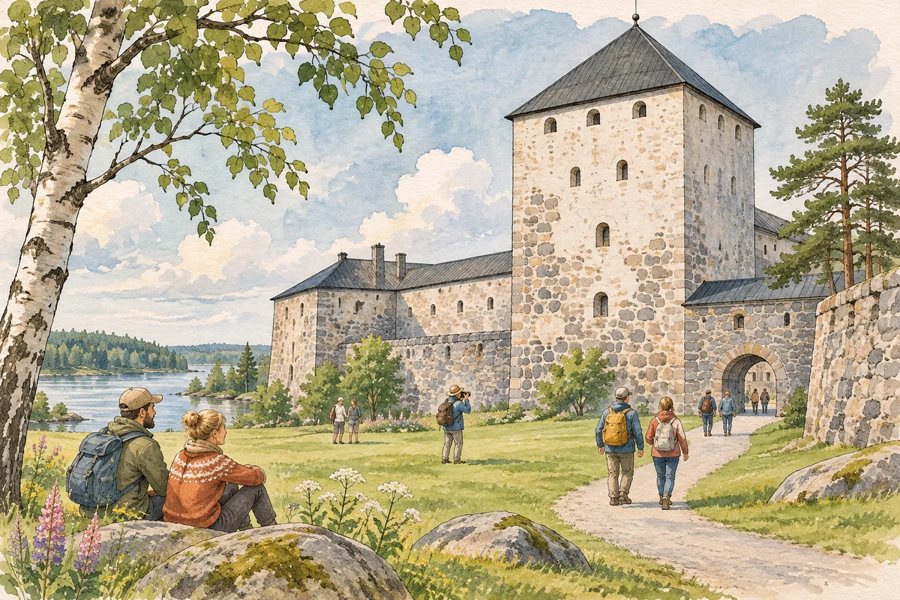 KI-generierte Illustration: Mittelalterliche Steinburg mit hohem rechteckigem Turm und Besuchern im Hof.
Photo: Max-TD / OpenAI
From defensive stronghold to court life
The earliest parts of the castle were built as a defensive stronghold for the Swedish Crown. Court life took on particular importance in the 16th century: under Duke John and Catherine Jagiellon, the castle became a setting for courtly display. Its rooms evoke a time when administration, power and everyday life all unfolded within the same walls. The castle also served as a trading hub, barracks and museum. These transformations are more than a simple chronology: they explain why austere military architecture and lavishly decorated rooms stand side by side within the building. The different parts of the complex invite visitors to connect the functions of individual rooms and courtyards with the region’s political history.
Exhibitions bring everyday life to life
The exhibition in the Bailey takes visitors through the castle’s history, from the 13th century to the present day. The focus is not only on rulers and military events, but also on court society, servants, festivities and everyday life in the castle. Life-size figures depict Duke John, Catherine Jagiellon and Valpuri Innamaa, a merchant from Turku. A model from the time of Per Brahe offers a glimpse into the halls, kitchens and even a 17th-century sauna. Nearly a thousand objects enrich the story, some of them found within the castle itself. Younger visitors have their own guide in the castle sprite, who tells stories about life in the castle from his perspective at selected stops. Those interested in history museums can combine their visit with a trip to Forum Marinum.
Rooms, courtyards and artefacts
The tour brings home the castle’s scale and the variety of its buildings. Battlements, courtyards and halls show how the complex was used and adapted over the centuries. The exhibitions reveal both the splendour of court life and the practical spaces where people cooked, administered the estate and worked. Together, they present a picture of the castle that goes beyond the idea of a purely military fortress. Particularly striking is the contrast between the thick, restrained exterior architecture and the stories unfolding inside. The address, Linnankatu 80, is in the harbour area; the castle works well as a destination in its own right or as part of a day spent exploring Turku’s old town, cathedral and waterfront.
The castle as part of a longer trip through Finland
Turku is a starting point for excursions along the southwest coast and into the archipelago. After visiting the museum, you can continue your maritime exploration with a cycling trip along the Archipelago Trail, a route that runs through island communities by road and seasonal ferry connections. To compare other historic sites, visit Suomenlinna, a sea fortress, or Olavinlinna, a medieval castle in the Saimaa region. Turku Castle, by contrast, brings the courtly history of the southwest to life especially vividly.
