
Ice Skating in Finland
Those who want to go ice skating in Finland can choose between maintained artificial ice rinks in cities and natural ice on lakes or in the archipelago. Artificial ice provides a clearly defined surface with regulated access and city-published condition updates. Natural ice, on the other hand, changes with currents, wind, snow, thawing weather and inflows; even a vast, wintry landscape says nothing reliable about the ice’s strength at a particular spot. For a relaxed first outing, a supervised or artificially refrigerated rink is usually the easier choice. Natural ice requires independent safety equipment and experience.
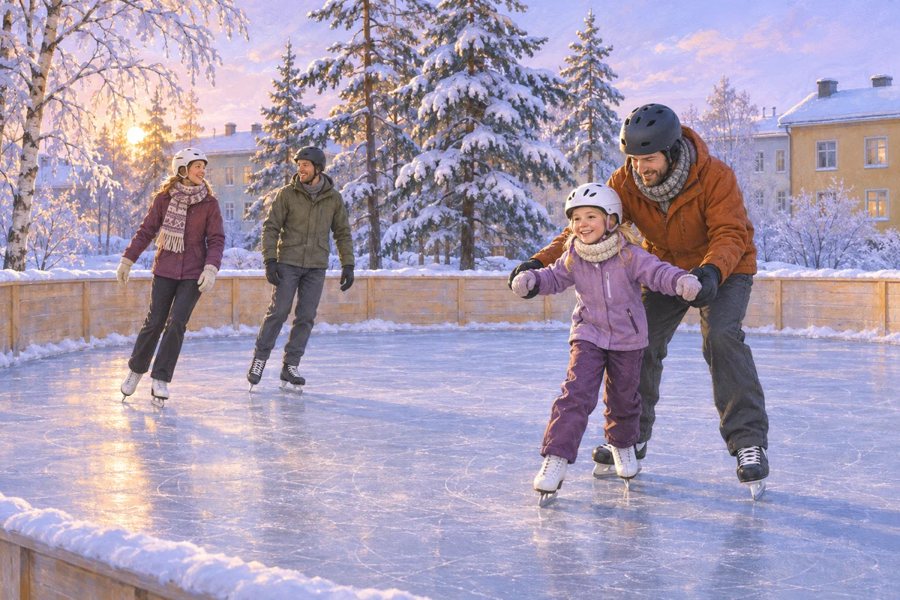 KI-generierte Illustration: Erwachsene und ein Kind mit Helmen beim Schlittschuhlaufen auf einer umgrenzten Eisbahn.
Photo: Max-TD / OpenAI
Ice skating in Finland: key facts
- Artificial ice rinks are maintained by cities and may open or close depending on the weather.
- Helsinki maintains numerous artificial ice rinks, including Oulunkylä, Brahenkenttä and Jätkäsaari.
- A lake or sea bay is not safe simply because the surface looks frozen or other people are skating on it.
- Natural ice requires local knowledge, suitable rescue equipment and a plan for changing ice conditions.
Artificial rink or natural ice?
An artificial ice rink provides a level, clearly marked surface where many people can practise their first steps. In Finland, facilities range from small neighborhood ice fields to larger sports rinks; some are open for recreational skating, while others divide the time or space between public skating and ice hockey. The city publishes public skating times and any exceptions for each facility; the city’s location pages also list access details and rules of use.
Natural ice offers a wide-open setting, but it is not simply an unmaintained version of an ice rink. Currents and inflows can create thin spots beneath the surface; conditions are especially changeable under bridges, by reed beds, at inlets, along coasts and near shipping channels. Snow cover hides cracks and uneven patches. A cold spell or ice that looks thick does not replace a local assessment. Helsinki Rescue Services warns that the thickness of the ice or other people’s tracks cannot be taken as proof of safety; sea and harbor areas are particularly hazardous because of vessel traffic and moving ice.
Ice skating in Helsinki: maintained rinks in the city
Helsinki, whose city profile also describes leisure activities, maintains artificial ice surfaces at various locations. Oulunkylä and Brahenkenttä are listed as larger artificial rinks with public skating times; schedules and any exceptions are provided for each ice field. In the southwest, Jätkäsaari Sports Park also has an artificial ice rink. Helsinki has eleven artificial ice rinks that are free to use during public skating hours; some rinks divide their schedules between public skating and hockey. The information makes it easy to plan a visit as part of a day in the city.
Lahti also lists frozen lakes as places for winter recreation, weather permitting. This local option is not blanket approval to use other lakes or to skate throughout the season.
Natural ice: clear limits and practical precautions
On open water, wind and currents can change conditions. Near the coast, shipping routes, harbors, bridges and flowing water, ice can open up, break or refreeze. Snow acts as insulation and makes it harder to see the surface; rain and mild days weaken ice even if the nights are still cold. Fragile, granular areas are especially common in spring, and they do not bear weight like clear, solid ice. A measurement taken at a single point does not prove that the entire area is safe; nor do other people’s tracks constitute a safety clearance.
Consider natural ice only on routes that are explicitly approved and have a current local assessment; if there is no reliable clearance, stay ashore. A frozen area may be unsafe at the opposite end because of an inflow or current. Keep away from bridges, inlets, reeds, open water, shipping lanes and ferry areas. Anyone taking part in a designated natural-ice activity needs a partner, rescue tools carried on their person, a change of clothes packed in a waterproof bag, and a means of communication. Children should use secured ice surfaces and remain under direct supervision.
When in doubt, the right choice is to stay off natural ice. A frozen lake is not a reliable substitute for a maintained rink. General travel information about Finland’s climate and winter conditions describes seasonal differences, but does not replace local clearance of the ice.
Skates, clothing and small groups
If you are planning other winter activities instead of a visit to an ice rink, winter safaris in Finland offers examples of activities, each with its own participation and safety requirements. For an artificial ice rink, choose well-fitting skates, warm gloves and several adjustable layers of clothing. A helmet is especially useful for children and beginners; knee and wrist guards can help cushion falls when you are starting out. Skates should be laced firmly without restricting circulation. Spare socks, an extra layer and a warm place to change make the outing more comfortable. Beginners should skate near the edge, watch the direction of travel and other users, and take breaks away from the skating lanes.
Frequently asked questions about ice skating in Finland
Is a frozen lake automatically safe?
No. Ice may be thin or unstable near currents, inlets, bridges, coasts and other features. Snow hides hazards, and temperature alone does not prove that the ice is strong enough. Use only explicitly secured routes or an artificial ice rink.
Where can I find artificial ice in Helsinki?
Artificial ice rinks include Oulunkylä, Brahenkenttä and Jätkäsaari. Skating times and any exceptions are listed for each facility and may vary by season.
Can I rent skates?
Helsinki lists skate-rental options at libraries; availability and terms vary by location.
What do I need for natural ice?
Natural ice is suitable only for people with a current local assessment, appropriate rescue equipment and the necessary skills. This includes ice picks, a throw line, a change of clothes, a companion and a plan. If there is no clearance or you lack experience, stay on land or use a maintained rink.
