
Karelian Pasties
Karjalanpiirakka: the open-faced rye pasty
Karjalanpiirakka, usually called Karelian pasties in English, are small, oblong pastries with a thin rye crust and a visible filling. The best-known filling is rice porridge; regional and modern versions also use potatoes or barley. The dough is rolled out thinly, the filling is placed in the middle, and the edges are folded over it in regular pleats. The folded rim leaves the filling visible and gives the pastry its characteristic shape. The dish comes from Karelian food culture and is now known throughout Finland. For more dishes and ingredients, see the overview of Finnish cuisine.
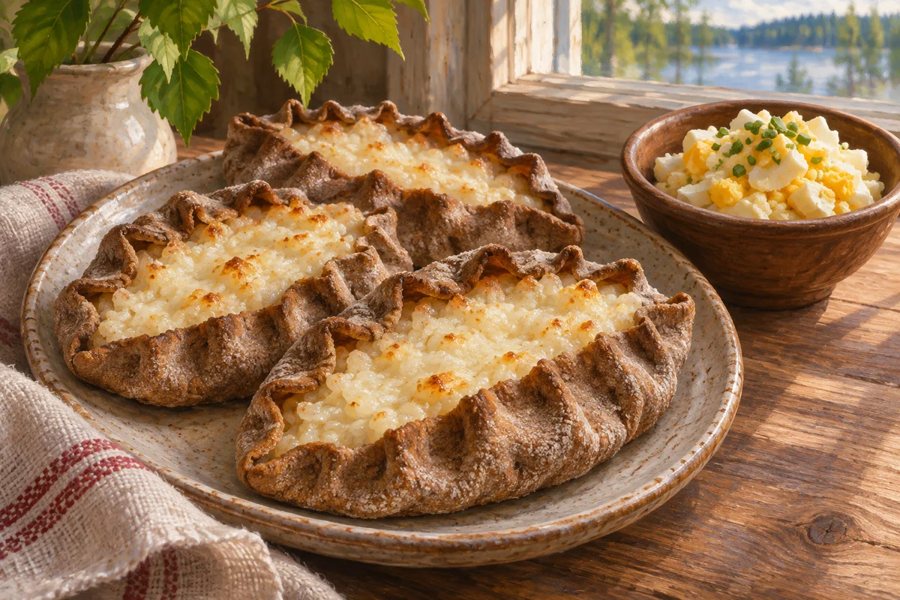 Karelische Piroggen mit Reisfüllung und Eierbutter – KI-generierte Illustration.
Photo: Max-TD / OpenAI
Rye, rice and traditional preparation
The classic crust is made from rye flour, water and salt. Rye gives it a dark color and a robust flavor, while the soft rice filling provides a mild contrast. For the filling, rice is cooked in milk into a porridge and left to cool before the dough pieces are shaped. The European Union lists Karjalanpiirakka as a Traditional Speciality Guaranteed. The name is tied to a traditional recipe and method of preparation. In everyday life, however, the pastries vary in size, recipe and bakery.
Munavoi and typical occasions
The pasty is often served with munavoi, a mixture of hard-boiled egg and butter. On the warm pastry, the egg butter softens and complements the savory crust. The pasty is suitable for breakfast, as a light snack or as part of a cold buffet; it is also eaten with coffee. Rye features in many Finnish dishes, including rye bread. Trying different baked goods makes it easy to compare the soft rice filling and firm, aromatic crust with other rye pastries.
Storing and serving
Freshly baked pasties taste good warm, but can also be served cooled. For a group, the small pastries can be arranged on a platter, with the egg butter served separately. This helps the surface stay firm for longer. When shopping in Finland, ingredient labels provide information about fillings and possible allergens. To make them at home, shape the dough shells thinly and add a fairly firm filling so the edges can be folded neatly. The dish illustrates how a few basic ingredients can become a distinctive regional specialty. The article also places the landscapes of Karelia and Finland within nature in Finland.
