
Shipbuilding and Finland’s Maritime History
Finland’s position between the Baltic Sea, its archipelagos and northern sea routes has shaped its economy and everyday life for centuries. Shipyards built not only merchant ships, but also passenger ferries, research vessels, icebreakers and cruise ships. The history of shipbuilding is especially evident in two cities: shipbuilding began on the banks of the Aura River in Turku in 1737, while the Hietalahti Shipyard in Helsinki was founded in 1865. Each developed its own specialities.
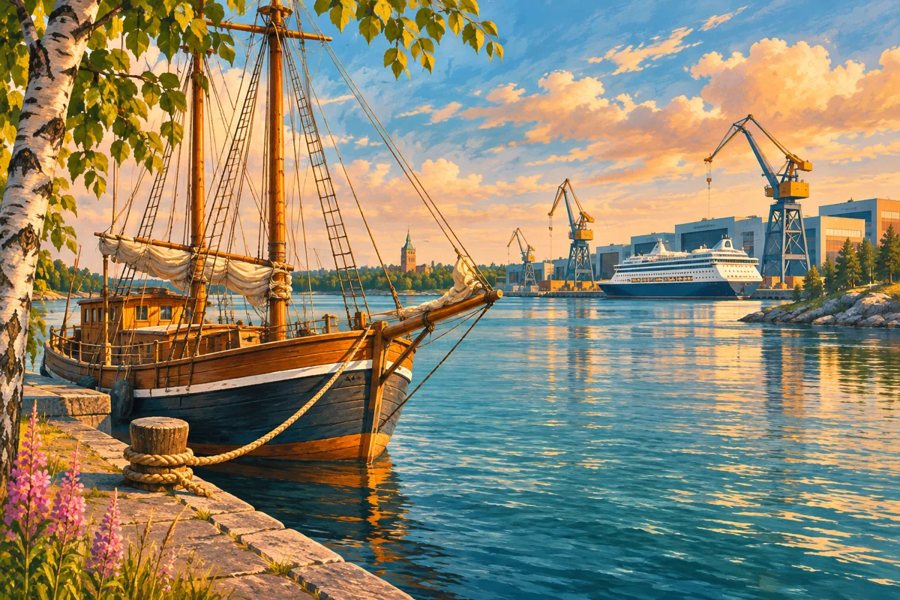 KI-generierte Illustration: Traditioneller Segler am Kai, im Hintergrund Hafenkräne und ein modernes Passagierschiff.
Photo: Max-TD / OpenAI
A long tradition in Turku
Industrial shipbuilding in Turku dates back to 1737, when construction of wooden ships began on the banks of the Aura River. In the 19th century, the Vulcan Shipyard and other businesses joined the industry; after a series of mergers, shipyard operations eventually moved to the Perno site. The industry expanded rapidly after the Second World War: reparations contracts made heavy demands on shipyard capacity, while the start of series production brought new requirements for shipbuilding companies. For generations, the city remained a centre for large ships. Moving shipyard operations from the riverbank in the city centre to Perno, farther west, made it possible to build larger vessels.
Over the course of the 20th century, ownership and company names changed several times. The shipyard’s history includes Crichton-Vulcan, Wärtsilä, Masa-Yards, Kvaerner, Aker and STX, each operating during a distinct period. These names are not simply interchangeable labels for the same company: mergers, takeovers and joint ventures reshaped Finland’s shipbuilding industry. Today, Meyer Turku operates the Perno shipyard, where it builds large cruise ships and other sophisticated vessels.
Cruise ships and different shipyard specialities
Turku is known internationally above all for its large cruise ships. Ships built here include Oasis of the Seas and Allure of the Seas, as well as more recent vessels in the Icon class, including Icon of the Seas and Star of the Seas. Ships of this size require extensive indoor facilities, large dry docks and the coordination of numerous suppliers. Passengers may rarely see the shipyard or its equipment before launch, but the ships built there go on to shape cruise offerings around the world. Finland’s ferry and cruise connections are a distinctive part of Baltic Sea shipping; an overview of these cruises and sea voyages in Finland can be found in passenger services between coastal ports.
Helsinki also has an important shipbuilding history: founded in 1865, the Hietalahti Shipyard built cruise ships and ferries, and later specialised vessels. Ships built in Helsinki include Carnival Miracle and Costa Atlantica. Turku and Helsinki have always been distinct shipyard locations, with their own periods of activity and contracts. Rauma also played an important role in Finland’s wider shipyard network, particularly in the construction of ferries and specialised vessels. The southern coastal city of Kotka is also closely connected with seafaring.
Maritime history to explore
In Finland, the history of industry can be experienced beyond shipyard archives. In Turku, Forum Marinum is dedicated to the history of seafaring and maritime culture on the southwest coast, in the Archipelago Sea and across the Baltic. Exhibitions in museum buildings are complemented by historic ships. Together, they show how trade, passenger traffic, the navy and shipbuilding are interwoven. The nearby Aura River is more than just a backdrop: shipbuilding developed along its banks, and museum ships now moored there offer vivid reminders of different eras.
Turku is also an important passenger port; the Port of Turku connects the city to today’s ferry and passenger services across the Baltic Sea. Here, modern industry, historic ships and the Baltic Sea’s role as a transport route come together. Finland’s shipbuilding history is not a thing of the past: it extends from wooden sailing ships to ferries and icebreakers, and on to today’s large cruise ship projects.
