
Cruises and sea travel in Finland
Finland’s location on the Baltic Sea makes the country an important starting point for sea voyages in northern Europe. Regular ferry services run from Helsinki and Turku to Estonia and Sweden, while international cruise ships also call at Finnish cities. When planning a trip, it is therefore worth distinguishing between a booked cruise with several days on board, a short ferry trip, and a single shore excursion during a longer Baltic Sea itinerary.
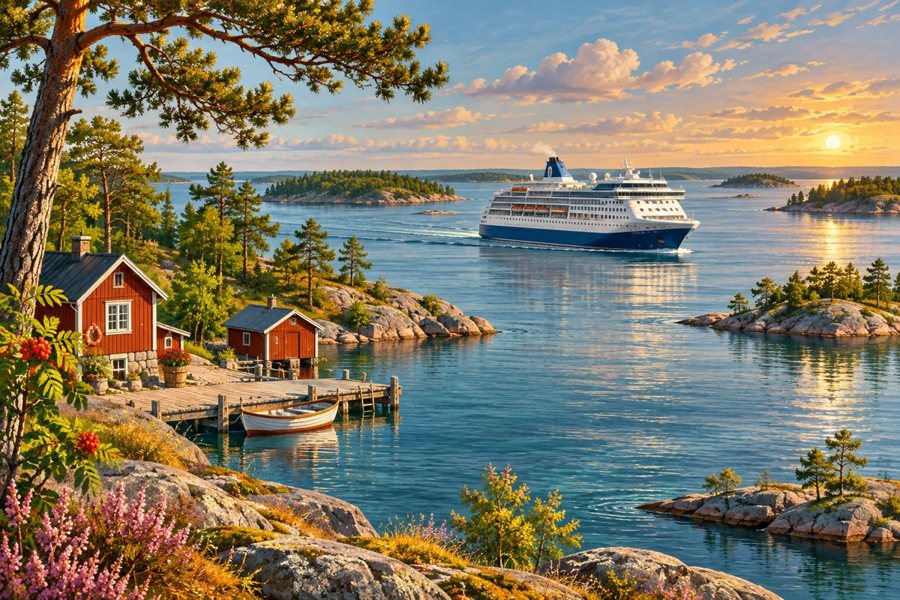 KI-generierte Illustration: Passagierschiff zwischen bewaldeten Schären vor roten Uferhäusern im Abendlicht.
Photo: Max-TD / OpenAI
Three ways to discover Finland by sea
A classic Baltic Sea cruise usually visits several countries and ports. Finland may be a port of call or the starting or ending point. Calls and time in port depend on the route and season. Depending on the itinerary, operators combine several countries and ports on a Baltic Sea cruise from Finland.
Scheduled ferries between Finnish and neighboring ports are a different option. They carry passengers and vehicles and can be used for a one-way crossing, a round trip, or a short getaway, depending on the route. Overnight sailings are offered by the ferry companies on the Helsinki–Stockholm and Turku–Stockholm routes; the crossing from Helsinki to Tallinn is considerably shorter. A mini-cruise combines a scheduled ferry crossing with a return trip and time on board; on a cruise lasting several days, by contrast, the ports visited change along the way.
A third option is to travel on an international cruise ship calling at Finland as part of a longer Baltic Sea itinerary. Guests go ashore for a few hours while the ship is in port. Such a shore excursion is not the start of a new trip. A Helsinki cruise port of call begins at the berth; the berth determines how to get around and how much time is available in the city.
Helsinki, Turku and Mariehamn
Helsinki is Finland’s largest passenger port. The passenger terminals for scheduled ferries are not all in the same port area: services to Tallinn depart from West Terminal 2, among other locations, while Viking Line ferries to Stockholm depart from the Katajanokka Terminal and Tallink Silja ferries from the Olympia Terminal. International cruise ships, in turn, use several berths, including Hernesaari, Katajanokka and the South Harbour. The specific berth is therefore crucial for getting to the port, arranging transfers and planning time in the city. A shore excursion or ferry stop in Helsinki can be combined with a visit to the city center.
Turku is an important Finnish departure port for ferry trips to Stockholm. The route passes through the archipelago and, by sea, through the Åland region. Tallink Silja and Viking Line operate ferries from the port, carrying both passengers and international vehicle traffic. The port has good connections to the city’s bus and rail services. A visit to Turku can be combined with the ferry trip.
Mariehamn in the Åland Islands is both a destination for scheduled ferries and a port of call for international cruise ships. The island group between Finland and Sweden gives many Baltic Sea itineraries a distinctive maritime character. Scheduled ferries connect Mariehamn with ports in Finland and Sweden; international cruise ships also call at the city. Passenger and cruise ports in Finland shows the different roles of these ports.
Choosing the right type of trip
The key to choosing the right type of trip is whether a particular port is the destination of a scheduled ferry service or a stop on a cruise lasting several days. For a ferry, the departure and arrival ports determine the route; for a cruise, the itinerary, time in port and organized shore excursions matter. A mini-cruise is a good choice for a short stay on board, while a longer Baltic Sea voyage offers more time to visit several countries and cities. The direction of travel also matters: a one-way crossing can be part of a longer journey, while a round trip returns to its port of origin.
Before departure, the terminal and departure time are just as important as the name of the port. Helsinki’s terminals are in different parts of the city. In Turku, separate routes lead to the passenger terminals, while in Mariehamn the port is part of the urban area. For international cruises, the berth is assigned for each call. With these distinctions in mind, Finland’s seaborne travel options are easy to compare: as a voyage across the Baltic Sea, a convenient connection between cities, or a single shore excursion as part of a longer itinerary.
