
Camping and Everyman’s Right in Finland
What the Everyman’s Right allows when camping
Finland’s Everyman’s Right makes it possible to enjoy nature even on land you do not own. This includes pitching a tent temporarily in areas where access is generally permitted. It is not blanket permission to stay on any property: keeping a respectful distance from homes, respecting privacy, protecting vegetation, and considering how the land is used by its owners all remain important. National parks and other protected areas have additional rules; camping there is often restricted to designated overnight sites. The overview Camping in Finland shows how enjoying nature freely can go hand in hand with organized campsites.
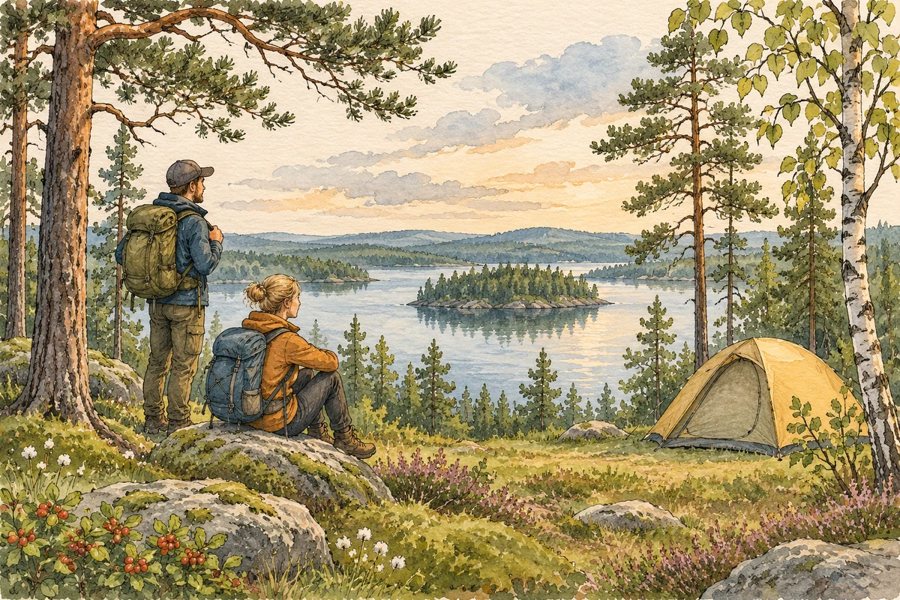 KI-generierte Illustration: Kleines Zelt und Wandernde an einem ruhigen bewaldeten Seeufer.
Photo: Max-TD / OpenAI
A tent is not a motorhome
Temporary camping on foot must be clearly distinguished from staying overnight in a motor vehicle. Everyman’s Right does not give you the right to drive a car, campervan, or motorhome off-road or park in the countryside. Subject to local rules and due consideration for others, you may pitch a tent in a suitable natural area for a short night; a vehicle must remain on an authorized road or permitted parking area. A parking space is therefore not the same as a tent site or motorhome pitch; these areas are designated separately for their respective uses. For trips by vehicle, Motorhome trips in Finland offers a separate guide.
At a traditional campsite, the operator’s rules apply. Campsites have designated tent areas, sanitary facilities, and often other amenities. They are often a better choice if you need to stay longer, have access to water or electricity, or want a clearly defined pitch. An overview of organized options is available at Campsites in Finland. Wild camping and staying at a campsite are not opposites: they meet different needs and are subject to different rules.
Keep fire and cooking safely separate
One especially important distinction concerns open fires. Everyman’s Right does not include permission to light a fire on someone else’s land. You need the landowner’s permission; in national parks and other protected areas, fires are also often restricted to designated, maintained fire sites. Open fires are prohibited during a forest or grass fire warning. Where fires are permitted, use only the designated site and follow safe practices. Do not cut wood from living trees or strip their bark; stones are also unsuitable as a fire base because heat can damage them. A camping stove is a practical alternative, provided it is allowed at the location.
In natural areas, do not pitch a tent on fragile vegetation, in gardens, on cultivated land, or close to homes. Behaving quietly, keeping a respectful distance, and taking all rubbish with you are part of exercising Everyman’s Right. Do not leave food scraps, packaging, or hygiene products behind; they harm the landscape and wildlife. Keep water sources and paths accessible to other visitors. Low-growing plants, mosses, and lichens grow slowly and can be damaged by trampling.
Plan overnight stays in protected areas
In national parks, visitor rules determine where you may pitch a tent, whether certain areas are temporarily closed, and which facilities you may use. A general right to move around in nature does not override these local requirements. In national parks, overnight stays are limited to designated sites; in other protected areas, access to specific sections or times may be restricted. Marked trails pass through sensitive landscapes and help reduce trampling damage. For routes through different regions, Hiking in Finland offers inspiration. If you would like to use sanitary facilities and designated pitches in the evening, you can find them at campsites.
