
Motorhome travel in Finland
Exploring Finland by motorhome
A motorhome trip combines Finland’s lake and forest landscapes with the freedom to keep daily driving distances flexible. To make the journey enjoyable, it helps to distinguish clearly between driving, overnight stays and camping: the Everyman’s Right does not allow you to drive a motor vehicle cross-country or set up anywhere in nature with a motorhome. Driving means using public roads and designated access routes; for overnight stays, choose a campsite, a designated motorhome pitch or a car park where overnight parking is permitted. The guide to Camping in Finland explains the different types of overnight accommodation.
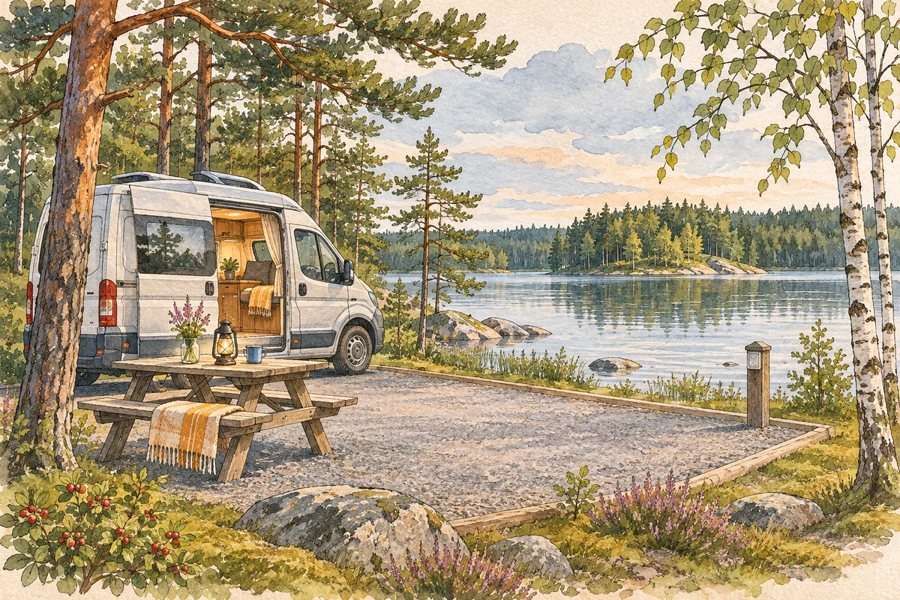 KI-generierte Illustration: Wohnmobil auf einem eingerichteten Stellplatz am See mit Picknicktisch.
Photo: Max-TD / OpenAI
The difference between motorhome pitches and campsites
A campsite offers longer stays with facilities, while a basic motorhome pitch is better suited to a short stop. Two examples illustrate the range: Karhunkainalo, on Lake Öllöri in Hossa, accommodates motorhomes and caravans and offers electrical hook-ups, a kitchen, toilets, showers, a sauna and laundry facilities. Kielo Camp is on an island in Pyhäjoki near Route 8; it has pitches with and without electricity, as well as tent sites. The size of your vehicle and the pitch you book determine what will suit you. Browse a selection of campsites in Finland.
At a nature area, motorhomes must remain in designated parking areas: you may not leave a car park to find a larger or quieter spot elsewhere. Overnight stays are permitted only in areas where the signs allow them. Within national parks, designated overnight areas for tents may have different rules from vehicle parking areas. One example is the Iso-Syöte hiking area, where overnight stays in motorhomes are permitted in the car park. Campsites near nature areas also provide a clearly defined base for day hikes, while motorhomes remain on roads and in authorised parking areas.
Plan your driving and overnight stays responsibly
For a relaxed journey, realistic daily distances matter more than covering as many kilometres as possible. Finland is large and sparsely populated, with long stretches of forest and lake country between settlements. Plan breaks, shopping and waste disposal around your route and the facilities available. Waste and wastewater must be taken to designated disposal points, not left in the landscape or discharged into waterways. When using minor roads and unpaved access routes, consider the vehicle’s size, the road surface and the weather; a heavy or long vehicle cannot safely use every small access road.
Park a motorhome only where parking is permitted. Keep the vehicle within the marked area; furniture, awnings and barbecues belong on the pitch you have booked. Open fires are subject to separate rules: campsites designate places where fires are permitted, and all fires are prohibited when a fire warning is in effect.
Enjoy nature without driving cross-country
A motorhome takes travellers to hiking trails, nature centres and lakes, but not through sensitive terrain. Cars, campervans and motorhomes must remain on roads and in permitted parking areas. The Everyman’s Right mainly concerns low-impact activities on foot, by bicycle or on the water; it does not override rules on road access, land ownership or protected areas. Camping and the Everyman’s Right in Finlandexplains the key differences. For shorter walks and marked trails, Hiking in Finlandis a helpful place to start.
