
Markets and Market Halls in Finland
A visit to a market in Finland can mean many things: seasonal berries in a town square, smoked fish in a market hall, or second-hand clothes at a flea-market stall. Three Finnish words help you find your way around. Tori is a market square, kauppahalli is a permanent market hall, and kirpputori is a flea market. What is on offer varies by location and season; several types of market are often found close together.
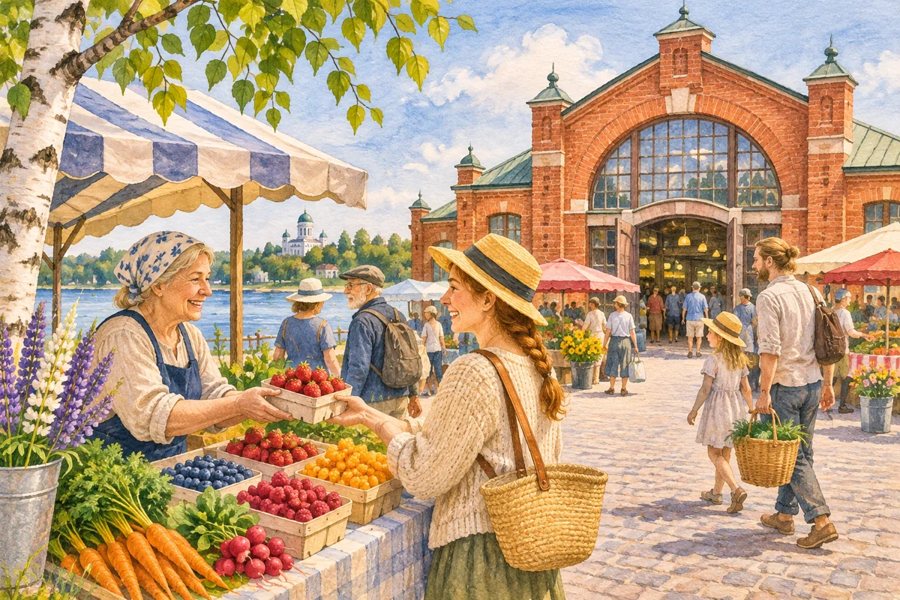 KI-generierte Illustration: Marktstände mit Gemüse und Beeren vor einer nordischen Backsteinhalle.
Photo: Max-TD / OpenAI
Tori: shopping outdoors
At a tori, vendors sell from stalls and small carts. Typical offerings include seasonal produce, flowers, pastries, fish, and hot snacks. In Kuopio, berries and vegetables in season are part of the market scene, along with the local specialty kalakukko; the square is also a place where people meet in everyday life. In Tampere, Tammelantori is known for its varied selection. In summer, strawberries, new potatoes, and flowers are among the highlights, while smoked fish is also available. In Oulu, Kauppatori, the historic warehouses, and the market hall together make up a popular destination by the harbor.
If you’d like to get a first impression of market life in Finland, you can visit the large squares in Helsinki at Kauppatori and the Old Market Hall, in Tampere around the market hall and Tammelantori, or in Kuopio, with its market square and market hall. The square is often a central meeting place for locals.
Kauppahalli: permanent stalls and shelter from the weather
A kauppahalli is a permanent, covered market hall with fixed shops and places to eat. It’s a place to discover food and specialties whatever the weather. Helsinki’s Old Market Hall is by the South Harbor; Hakaniemi Market Hall is a two-storey building that opened in 1914. Turku’s market hall dates from 1896 and occupies an entire city block. Butchers’ and fishmongers’ counters, delicatessens, bakeries, dairy products, restaurants, and cafés shape the selection. Tampere has a market hall on Hämeenkatu, opened in 1901, with vendors selling fish, meat, cheese, vegetables, baked goods, and specialties.
The combination of square and hall continues in northern cities: Oulu’s market hall stands right next to Kauppatori, and Kuopio’s hall is also by the market square. In Helsinki, the two-storey Hakaniemi Market Hall offers handicrafts and textiles as well as food. The Turku Market Hall brings together meat and fish counters, delicatessens, bread, cheese, restaurants, and cafés. In Oulu, the market hall, old warehouses, and Kauppatori are all close together. Permanent vendors predominate inside the halls, while seasonal stalls set up in the square outside.
Kirpputori: flea markets, second-hand goods, and vintage finds
Kirpputori means flea market, but the word covers several types of selling. At a self-service flea market, private sellers rent a shelf or table and put prices on their goods; staff handle the sales. Other shops sell donated goods or combine self-service with consignment sales. These permanent shops are generally open regardless of specific event days. A street flea market, by contrast, is held outdoors in a square and may depend on the season, the weather, or a particular event date. Hietsu in Helsinki is a well-known example of a summer flea market at Hietalahti Square.
Antique shops and vintage boutiques are another distinct category: they are permanent stores with a curated selection, while an antiques or collectors’ fair is temporary and brings several vendors together at one venue. For fresh ingredients, try weekly and food markets. Second-hand clothes, dishes, or furniture can be found at flea markets and second-hand shops; for collectibles and older design objects, look to antique, vintage, and collectors’ markets.
Which market is right for what?
For fresh ingredients and a snack outdoors, a tori is a natural choice; for food under a roof, delicacies, or a break in a café, head to a kauppahalli. If you’re looking for second-hand clothes, dishes, or furniture, try a kirpputori or a second-hand shop. Vintage and antique shops or fairs are better suited to design, older collectibles, and high-quality one-off items. Specialist shops add Finnish products and souvenirs to the market mix, which are also popular when shopping in Finland. Crafts, glögi, and seasonal pastries are part of Christmas markets in Finland.
Frequently asked questions about markets in Finland
What does “tori” mean?
A tori is a public market square where vendors sell goods mainly from stalls and carts.
What is the difference between a tori and a kauppahalli?
A tori is outdoors in a square. A kauppahalli is a permanent, covered hall with fixed stalls and often cafés and restaurants.
Is every kirpputori a street market?
No. Many kirpputorit are permanent indoor shops with self-service stalls or donated goods. Street flea markets, by contrast, take place outdoors and are often held only seasonally or on a specific event day.
