
Weekly Markets and Food Markets in Finland
Finnish food markets combine shopping with time spent in a public square or historic hall. At a tori, market stalls are set up outdoors; a kauppahalli has permanent shops and counters inside a building. The products on offer depend on the season and the city. Berries, vegetables, flowers, fish and pastries are among the typical finds, though each market has its own specialities.
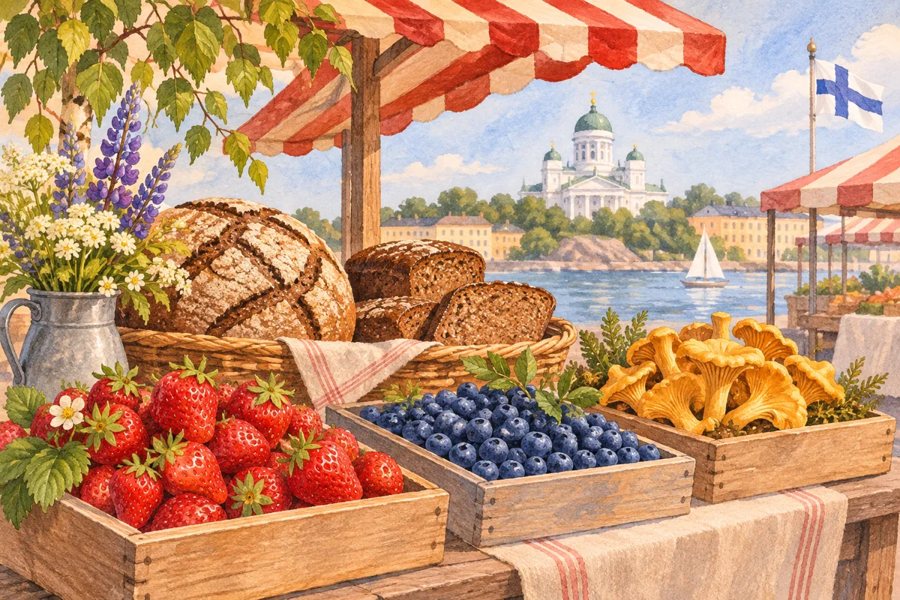 KI-generierte Illustration: Beeren, Pfifferlinge und Roggenbrot an einem Marktstand am Wasser.
Photo: Max-TD / OpenAI
Weekly markets and town squares
The Finnish word tori primarily means a market square. You’ll find traders’ stalls and food vans there; a market may be lively on several days, but the word alone does not specify a particular day of the week. Opening hours also vary across the country. When planning a trip, it is therefore worth distinguishing between the permanent location and a specific weekly or seasonal market. The square remains, while individual traders and events may vary.
In Kuopio, the market square is an important meeting place in the city centre. In summer, berries, vegetables and other seasonal produce feature prominently; kalakukko, a baked loaf filled with fish, is also part of the local food culture. Tammelantori in Tampere is known for its varied selection. In the warmer months, you’ll find flowers, strawberries and new potatoes, among other things, as well as smoked fish.
Market halls for local food
A kauppahalli is a covered market hall with permanent stalls. It is especially useful when you don’t want your shopping to depend on the weather or are looking for several types of food in one place. Turku Market Hall was completed in 1896 and extends across an entire city block. Traditional meat and fish counters sit alongside delicatessens, bakeries, cheese and dairy shops, restaurants and cafés. The hall is therefore both a place to shop and somewhere to take a break.
Tampere Market Hall opened in 1901. More than 30 vendors sell fresh fish, meat, cheese, vegetables, bread, pastries and chocolate there. In Helsinki, the Old Market Hall by the South Harbour is a historic market building; the two-storey Hakaniemi Market Hall combines food on the ground floor with shops selling crafts, textiles and other goods upstairs. The Old Market Hall and Kauppatori in Helsinki are by the South Harbour; the Hakaniemi Market Hall offers food and other goods on two floors.
Northern markets by the harbour and in the city centre
Oulu’s Kauppatori brings the market hall, historic storehouses and square together in close proximity. The storehouses are home to small shops selling crafts, clothing and decorative items; the square itself has vegetable and food stalls as well as places to eat. Kuopio’s market hall is also part of the market square, sustaining local market culture beyond the summer season. In Oulu, the market square, market hall and historic storehouses are close together. The Turku Market Hall dates from 1896 and combines traditional counters with cafés and restaurants.
What’s in season
The calendar has a particular influence on the selection of fresh produce. In summer, berries, vegetables and new potatoes are obvious examples in the cities mentioned here. Market stalls also offer flowers, fish and snacks, while the halls add permanent counters and speciality shops. For a picnic, choose baked goods, fruit or local snacks that are easy to carry. If you want to take something home, distinguish between fresh and non-perishable goods, and plan for refrigeration if buying fish or dairy products. Alongside food, Finnish design and souvenirs are also part of shopping in Finland.
Weekly market, market hall or flea market?
A food market is not the same as a flea market. At a tori, fresh food and other new goods are usually on offer; a market hall brings together permanent specialist retailers under one roof. A kirpputori is a flea market selling second-hand goods, often in a permanent self-service shop. If you’re looking for used items rather than ingredients, you’ll find relevant information in Flea markets and second-hand shopping in Finland. Christmas markets are seasonal events, distinct from regular food stalls; Christmas markets in Finland are covered separately.
Frequently asked questions about food markets
What should you try at a Finnish market?
What’s available depends on the place and the season. Berries, vegetables, pastries and fish are common market products; in Kuopio, kalakukko is one of the local specialities.
Are market halls open every day?
Market halls are permanent establishments, but individual vendors may have different opening days. The word kauppahalli alone does not tell you the specific opening hours.
What does tori mean?
Tori is the Finnish word for a market square, where vendors often sell seasonal food and snacks.
